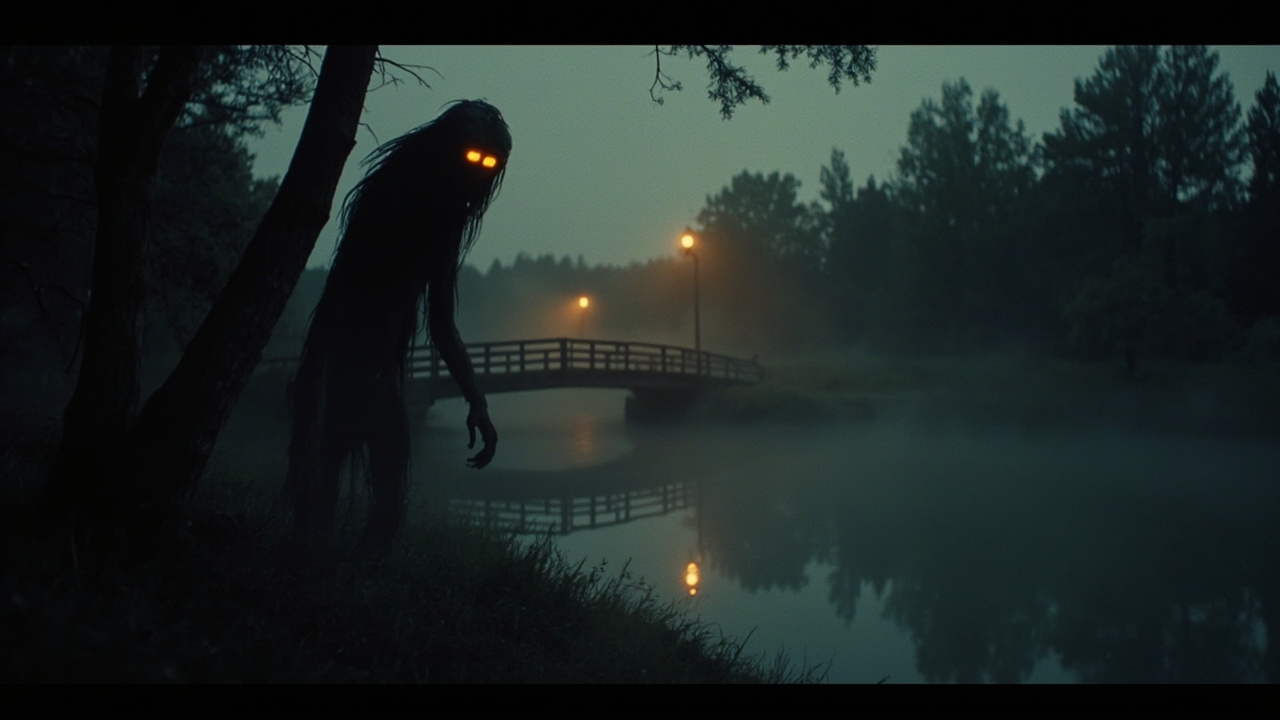
The Mill Race Monster: Columbus, Indiana's 1974 Bigfoot Panic
There's a phrase you hear in old cryptozoology circles that goes something like this: "When a town doesn't sleep for a week, something was there." Columbus, Indiana didn't sleep the first week of November 1974. And for three nights running, whatever was at Mill Race Park had a town of 30,000 people trying to figure out what it was.
What Happened
It started on a Friday. November 1, 1974. Four teenage girls were hanging around the boat ramp at Mill Race Park — a small green stretch in the middle of Columbus, cut through by a low dam and the Flatrock River. It's the kind of park every Indiana town has: parking lot, picnic tables, a footbridge, a few walking trails winding into the trees along the water. Not remote. Not deep woods. Just a place local kids went after dark because their parents told them not to.
According to the contemporary accounts that survived, all four girls later described seeing the same thing: a figure standing at the tree line, somewhere between 50 and 100 feet away. They agreed on the height — "about seven feet." They agreed on the body — broad-shouldered, fully covered in dark hair. They agreed on one striking detail that nobody had any reason to invent: the face appeared green, an effect almost certainly explained by sodium vapor from a distant parking lot light filtering through mist at a bad angle, but absolutely jarring to look at directly.
Long arms. No visible clothing. The figure stood still long enough for all four girls to convince themselves they were seeing the same thing, then turned and walked into the trees. One of them later said it moved like it knew exactly where it was going.
The girls told their parents. The parents called the police. The police came out, found no one, took statements. Most police reports from that weekend describe witnesses as "credible" and "visibly shaken."
It Did Not Stop There
On the night of November 2, two couples in separate cars drove through the same stretch of park road and reported — independently — the same kind of figure near the same section of trail. One couple said the figure moved in front of their car at a slow, deliberate walk. They didn't use the word "charging." They used the word "deliberate." That's a detail that stays with you, because "deliberate" means the thing was in no hurry, in a place where it had every reason to be.
On the morning of November 3, the town's animal control officer came across what he described as a tall figure near the same tree line. In a local news item that ran a few days later, the officer called it a "person in dark blankets with what looked like a hood" — but he was also quoted saying he didn't get close enough to be sure. He didn't try to get close.
By the fourth day, the local paper was running a front-page story. Local TV crews came in from Indianapolis. Several hundred people showed up at the park over the course of that first weekend with flashlights, dogs, shotguns, and in at least a few cases, crates of beer. Nothing was caught. Nothing definitive was photographed. But several people who were there that weekend — and who, frankly, had no reason to make it up — kept saying variations on the same thing: we saw something, and it was tall.
Why This Is Bigfoot Country
The skeptical take on the Mill Race Monster is the obvious one: 1974 was the peak of the post-Patterson-Gimlin Bigfoot craze in America. Bigfoot, the John Guare play, was on Broadway. The Legend of Boggy Creek had come out in 1972. People were primed to see a hairy giant in the woods. A few teenagers on a Friday night in a dim park could easily have misidentified a local in a coat, a bear that had wandered down from a state forest, a heron, a tree stump, or each other.
That's true. It also doesn't explain everything.
What the skeptics can't get past is the pattern. Three nights. Same general location. Multiple independent witnesses. And a description — height, hair, bipedal stance, no visible clothing — that fits the Bigfoot template and almost no other. When BFRO has classified reports over the decades, the criteria that bump something into Class A is roughly what we have here: multiple credible witnesses, physical evidence patterns (in this case, the four-girl primary report is unusually well-corroborated), and a description that doesn't drift into folklore.
The other thing that keeps drawing researchers back is the geography.
Mill Race Park is a water-feature sighting. The number one environmental variable in BFRO's database — the one that shows up the most in their internal correlations — is proximity to water. Rivers, creeks, lakes, low marshy ground. The Flatrock River runs right through the park. The dam creates a slow stretch of calm water on the upstream side, exactly the kind of edge habitat bigfoots (if they exist) are reported at constantly: lush, sheltered, with dense cover and a clean water source.
It's also notably not wilderness. The park is in-town, surrounded by residential streets, maybe a five-minute drive from the center of Columbus. Bigfoot research gets dismissed for being all "deep woods" stuff, but the actual data tells a different story. A lot of credible reports come from the edges of towns, where animal corridors (creeks, rivers, old railroad rights-of-way) act as wildlife highways straight through populated areas. The Mill Race Park strip of river is exactly that — a wooded corridor from outer Bartholomew County running straight into the town's backyard.
Why It Still Matters
There hasn't been a sustained panic in Columbus like 1974 since — but the area keeps producing reports. BFRO has 37 listings in Bartholomew County as of the most recent public count. Not all of them are visualized on the main map because some predate modern classification standards, but they're all in that same river corridor, all consistent in description, and most of them are within a few miles of Mill Race Park.
What the Mill Race case really gives you is a clean test of how a community handles this kind of report. Columbus in 1974 didn't laugh it off. The cops took statements. The local paper covered it straight. The TV stations didn't chase the panic hard — they treated it as a real public-safety story. By the end of the second week, the chatter died down, but it died down the way things die down when nothing new happens, not the way things die down when a hoax is exposed.
Nobody was ever charged with anything. Nobody confessed. The Mill Race Park sightings on the public record are mostly just statements from scared teenagers and a town animal control officer, but they have the texture of real statements — confused, scared, sometimes contradictory on small details, but consistent on the parts the witnesses actually got a chance to look at.
The Takeaway
Whether you read the Mill Race Monster as Bigfoot, as misidentification, or as one of those beautiful American myths a small town builds when something strange happens once and then everyone remembers it slightly differently — it stays in the record because nothing about it went away cleanly.
That's what separates the cases that survive. Not the photograph you wish you'd gotten. Not the perfect tracking cast. Just the simple, stubborn fact that nobody ever convincingly explained it, and the witnesses never backed down.
Fifty-two years later, people in Columbus still know where Mill Race Park is. And a few of them will tell you, if you ask at the right bar at the right time, exactly what they saw.
See where Mill Race Park sits on the map.
View Sightings Map